

What is NAD+?
NAD+ is nicotinamide adenine dinucleotide, a coenzyme found in every living cell. This guide answers what is NAD+, and the question most people search for next, NAD+ vs NADH: how the two forms differ, the numbers that identify each, how a lab tells them apart, and why NAD+ is not a peptide.
What NAD+ is
NAD+ is a dinucleotide: two nucleotides joined through their phosphate groups.
- One nucleotide is adenosine monophosphate: the base adenine, a ribose sugar and a phosphate.
- The other is nicotinamide mononucleotide: nicotinamide, a ribose sugar and a phosphate.
The two phosphates are bonded to each other, so the molecule is often drawn as two halves meeting at a diphosphate bridge. Its international non-proprietary name is nadide. Older papers call it coenzyme I, cozymase or DPN, short for diphosphopyridine nucleotide.
Is NAD a peptide or a coenzyme? A coenzyme. A peptide is a chain of amino acids joined by peptide bonds, and NAD+ has neither: it is built from two bases, two sugars and two phosphates. We list it with our peptides because it comes in the same pre-filled pen format.
NAD+ vs NADH
NAD+ and NADH are two forms of the same molecule. NAD+ is the oxidised form and NADH the reduced form, and they differ only in the nicotinamide ring.
- In NAD+, the nicotinamide ring is a pyridinium ring. It is aromatic and carries a positive charge, which is what the "+" in the name refers to.
- In NADH, the same ring has taken up a hydride: one hydrogen nucleus with two electrons. The ring becomes a 1,4-dihydropyridine, is no longer aromatic and no longer carries the charge.
Written as an equation: NAD+ + H+ + 2 e− ⇌ NADH. The adenine half of the molecule is the same in both forms. That makes nad+ vs nadh structure a question of one ring and two hydrogen atoms: as neutral molecules, NADH has two more hydrogen atoms than NAD+, so it is 2.016 mass units heavier.
| NAD+ | NADH | |
|---|---|---|
| Form | Oxidised | Reduced |
| Nicotinamide ring | Pyridinium, aromatic, positively charged | 1,4-dihydropyridine, not aromatic |
| Absorbs light at 340 nm | No | Yes |
| Most stable in solution | Mildly acidic | Mildly alkaline |
Identity facts
| NAD+ | NADH | NADP+ | |
|---|---|---|---|
| Full name | Nicotinamide adenine dinucleotide | Reduced nicotinamide adenine dinucleotide | Nicotinamide adenine dinucleotide phosphate |
| Other names | Nadide, coenzyme I, cozymase, DPN | DPNH, beta-NADH | Coenzyme II, TPN |
| Molecular formula | C21H27N7O14P2 | C21H29N7O14P2 | C21H28N7O17P3 |
| Molar mass | 663.4 g/mol | 665.4 g/mol | 743.4 g/mol |
| Monoisotopic mass | 663.109 | 665.125 | – |
| CAS number | 53-84-9 | 58-68-4 | 53-59-8 |
| PubChem CID | 5892 | 439153 | 5885 |
The NAD+ figures are for the neutral molecule. PubChem also lists NAD+ as a positive ion, C21H28N7O14P2+ at 664.4 g/mol (CID 5893), and NADH is often supplied as a disodium salt, with its own CAS number, 606-68-8. A certificate that gives a molar mass should name the form it refers to.
NADP+ is NAD+ with one extra phosphate group, on the ribose of the adenosine half. That single phosphate is the whole difference between the two coenzymes, and it adds 80 to the molar mass.
How a lab tells NAD+ and NADH apart
The two forms are easy to tell apart in a lab, because only one of them, NADH, absorbs light at 340 nm.
- Light at 260 nm: both forms absorb here, because both contain adenine.
- Light at 340 nm: only NADH absorbs here, because of its reduced ring. Its molar absorption coefficient at 340 nm is 6,220 per molar per centimetre, a figure measured by Horecker and Kornberg in 1948 and still used today. NAD+ does not absorb at 340 nm.
- Fluorescence: NADH gives off blue light, near 460 nm, when it is lit at 340 nm. NAD+ does not.
- Mass spectrometry: the monoisotopic masses differ by about 2 units, 663.109 for NAD+ and 665.125 for NADH, so the two show as separate peaks.
Our guide to reading a peptide COA explains how purity and mass results appear on a certificate of analysis.
Stability in solution
NAD+ and NADH break down under opposite conditions. NAD+ is most stable in mildly acidic solution and breaks down in alkaline solution. NADH is the reverse: it is most stable in mildly alkaline solution and breaks down quickly in acid. Both break down faster when warm, which is why both are kept cold. Every R3vive pen, NAD+ included, carries the same storage line, "Store at 2–8°C"; our peptide pen storage guide covers storage in detail.
A short history
- 1906: Arthur Harden and William Young found that yeast juice needs a small, heat-stable substance to ferment sugar. They called it "coferment", later cozymase: this was NAD+.
- 1929: Harden and Hans von Euler-Chelpin shared the Nobel Prize in Chemistry for their work on sugar fermentation and its enzymes. Von Euler-Chelpin's group went on to show that cozymase is a nucleotide and to work out its structure.
- 1936: Otto Warburg and Walter Christian showed that the nicotinamide part of the molecule is where it takes up and gives up hydrogen, the difference between NAD+ and NADH described above.
- 1948: Bernard Horecker and Arthur Kornberg measured how strongly NADH absorbs light at 340 nm, the figure labs still use to measure it.
NAD+ in R3vive pens
| Pen | Strength | Volume | Concentration | Price |
|---|---|---|---|---|
| NAD+ | 1000mg | 3 ml | 333.3 mg/ml | £100.00 |
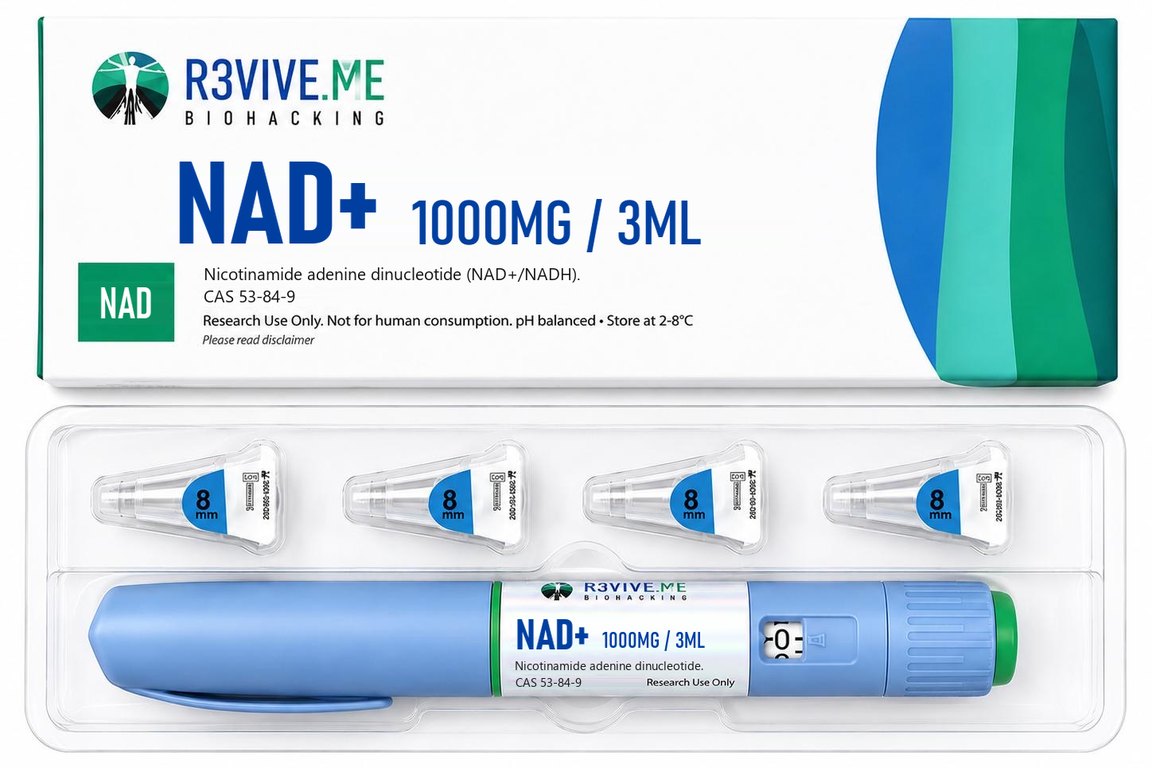
Our NAD+ comes as 1000mg in a pre-filled 3 ml pen at 99% purity, with 4 pen needle tips in the box. Most UK shops sell NAD+ as 250mg or 500mg vials of powder; this pen holds 1000mg, already in solution. Store at 2–8°C and refrigerate on arrival. The NAD+ pen page has the full details.
Sources
- PubChem, CID 5892 (nadide), CID 5893 (nadide cation), CID 439153 (NADH) and CID 5885 (NADP+): formulas, molar masses, monoisotopic masses, CAS numbers and synonyms, checked 15 November 2026.
- Harden A, Young WJ. Proceedings of the Royal Society of London B 77 (1906) 405–420: the first description of the coferment of yeast juice.
- The Nobel Prize in Chemistry 1929, Arthur Harden and Hans von Euler-Chelpin, nobelprize.org.
- Warburg O, Christian W. Biochemische Zeitschrift 287 (1936) 291–328: the hydrogen-carrying role of nicotinamide.
- Horecker BL, Kornberg A. Journal of Biological Chemistry 175 (1948) 385–390: the absorption coefficient of NADH at 340 nm.
- Lowry OH, Passonneau JV, Rock MK. Journal of Biological Chemistry 236 (1961) 2756–2759: the stability of the pyridine nucleotides in acid and alkali.
- catalogue/products.json: R3vive strength, volume, purity and storage line.
Products in this guide
All products are supplied for research purposes only.