

What is GHK-Cu?
GHK-Cu is the copper(II) complex of GHK, a tripeptide of three amino acids: glycine, histidine and lysine. This guide answers what is GHK-Cu: what the peptide and its copper complex are, the numbers that identify each, why a GHK-Cu solution is blue, and how AHK-Cu differs.
GHK, the tripeptide
GHK is glycyl-L-histidyl-L-lysine, written Gly-His-Lys, or GHK in one-letter codes. It was first isolated from human plasma by Loren Pickart, who described it in 1973. Its international non-proprietary name is prezatide.
GHK binds copper(II) ions strongly, through the histidine side chain and the peptide backbone, which is why it is usually supplied and studied as its copper complex.
GHK-Cu, the copper complex
GHK-Cu is GHK with a copper(II) ion bound to it. Cosmetic ingredient lists call it copper tripeptide-1, and its pharmaceutical name is prezatide copper. A GHK-Cu solution is blue: the colour comes from the copper, as it does in other copper(II) compounds.
Identity facts
| GHK | GHK-Cu | |
|---|---|---|
| What it is | The tripeptide Gly-His-Lys | GHK with a bound copper(II) ion |
| Other names | Glycyl-L-histidyl-L-lysine, prezatide | Copper tripeptide-1, prezatide copper |
| Molecular formula | C14H24N6O4 | C14H23CuN6O4 (as a +1 ion) |
| Molar mass | 340.38 g/mol | 402.92 g/mol |
| CAS number | 49557-75-7 | 89030-95-5 |
| PubChem CID | 73587 | 71587328 |
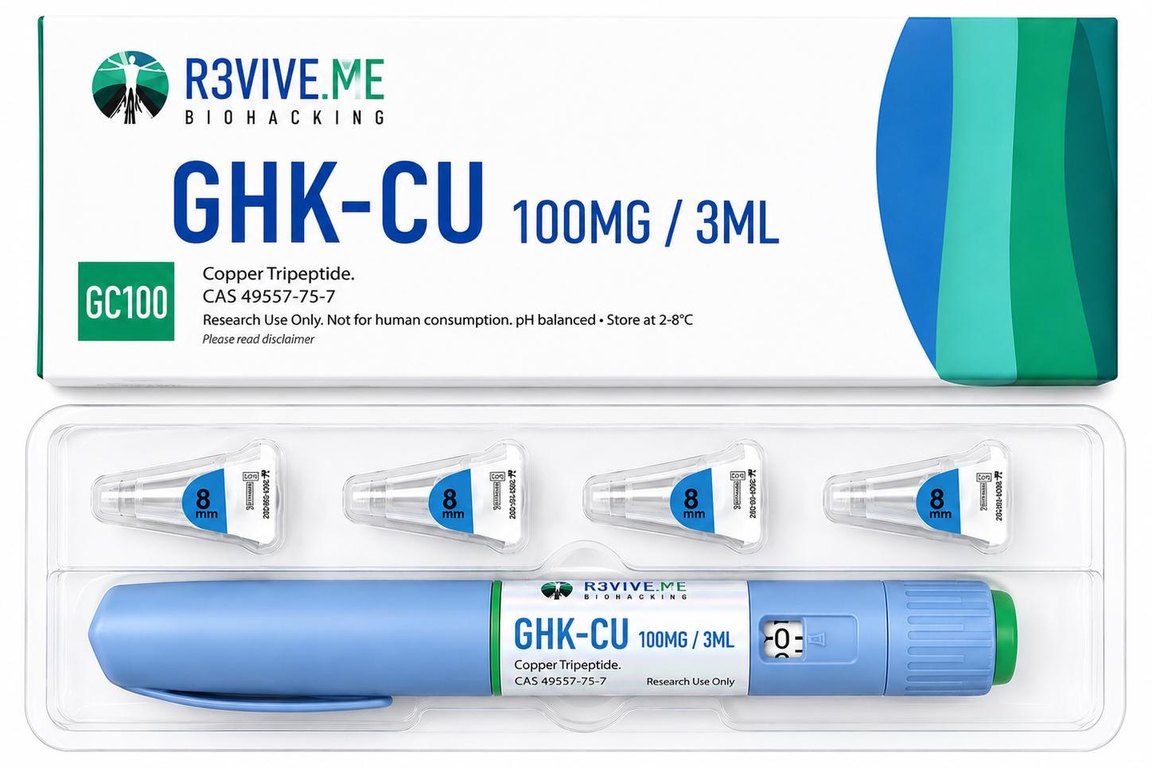
Supplier labels often give 49557-75-7 for GHK-Cu. That number belongs to GHK, the tripeptide on its own; the copper complex has its own entry, 89030-95-5. PubChem also lists other copper complexes, such as one copper ion with two GHK molecules, and the acetate salt, so a molar mass on a certificate should always name the form it refers to.
GHK-Cu vs AHK-Cu
AHK-Cu is the copper(II) complex of AHK, alanyl-histidyl-lysine. It differs from GHK-Cu in one amino acid: alanine takes the place of glycine at the start of the chain. Alanine carries a methyl group where glycine has a hydrogen atom, so AHK is one CH2 larger than GHK.
| GHK | AHK | |
|---|---|---|
| Sequence | Gly-His-Lys | Ala-His-Lys |
| First amino acid | Glycine | Alanine |
| Molecular formula (peptide) | C14H24N6O4 | C15H26N6O4 |
| Molar mass (peptide) | 340.38 g/mol | 354.41 g/mol |
| PubChem CID (peptide) | 73587 | 7408502 |
| Supplied as | Copper complex, GHK-Cu | Copper complex, AHK-Cu |
So ghk cu vs ahk cu is a question of one residue at the N-terminus: the His-Lys part of the chain, including the histidine that helps bind the copper, is the same in both.
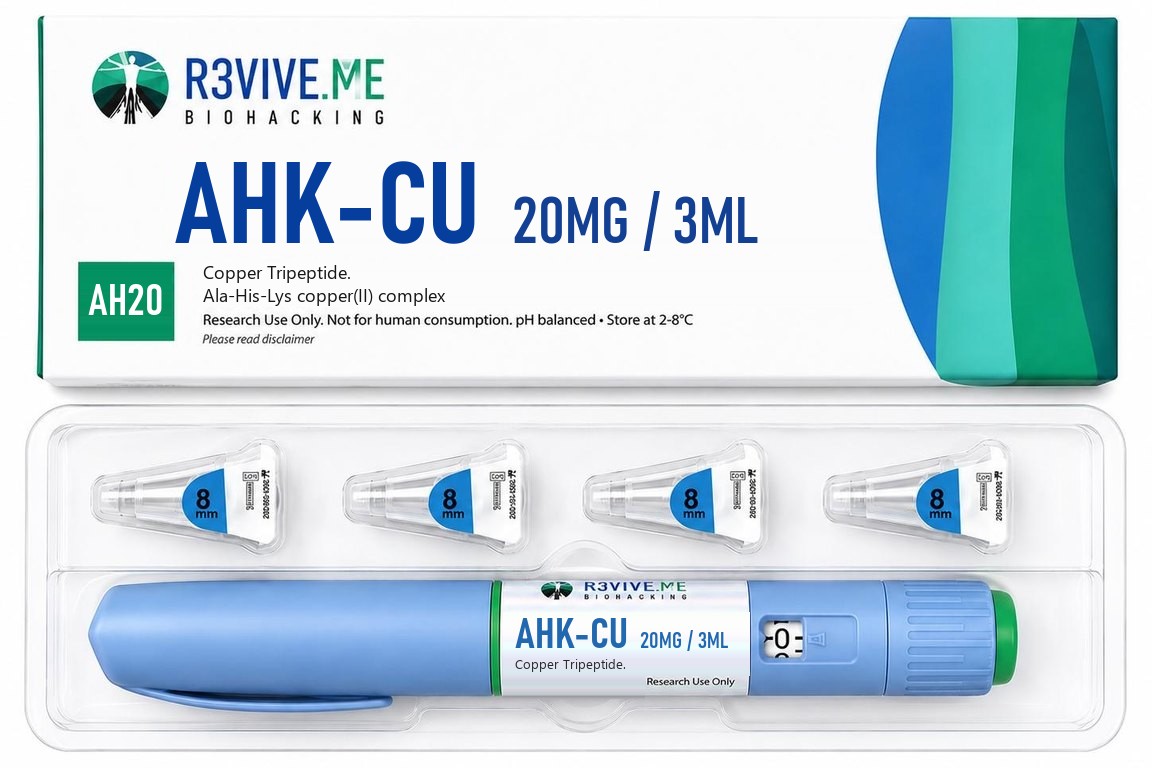
GHK-Cu and AHK-Cu in R3vive pens
| Pen | GHK-Cu | AHK-Cu | Total | Concentration | Price |
|---|---|---|---|---|---|
| GHK-Cu | 100mg | – | 100mg | 33.3 mg/ml | £112.00 |
| AHK-Cu | – | 20mg | 20mg | 6.7 mg/ml | £95.00 |
| GLOW | 50mg | – | 70mg | 23.3 mg/ml | £80.00 |
| KLOW | 50mg | – | 80mg | 26.7 mg/ml | £88.00 |
Every pen is a pre-filled 3 ml pen with 4 pen needle tips in the box, and every storage line reads "Store at 2–8°C". In GLOW and KLOW, GHK-Cu is the largest component by mg; our GLOW vs KLOW vs WOLVERINE guide has the full breakdown of each blend.
Sources
- PubChem, CID 73587 (glycyl-L-histidyl-L-lysine), CID 71587328 (prezatide copper) and CID 7408502 (L-alanyl-L-histidyl-L-lysine): formulas, molar masses, CAS numbers and synonyms, checked 30 October 2026.
- Pickart L, Thaler MM. Nature New Biology 243 (1973) 85–87: the first description of GHK.
- catalogue/products.json: R3vive strengths, volumes, blend components and storage lines.
Products in this guide


All products are supplied for research purposes only.