

What is Tirzepatide?
Tirzepatide in one paragraph
Tirzepatide (LY3298176) is a synthetic peptide of 39 amino acids developed by Eli Lilly. It is a dual agonist: one peptide chain that binds two receptors, the GIP receptor and the GLP-1 receptor. The chain is built on the sequence of human GIP (glucose-dependent insulinotropic polypeptide) and carries two non-coded amino acids, a C20 fatty diacid joined to a lysine side chain through a linker, and a C-terminal amide. This guide sets out its structure and the sources behind each fact. It makes no claims about use in people.
The sequence
In one-letter codes, with X standing for α-aminoisobutyric acid (Aib), the chain reads:
YXEGTFTSDYSIXLDKIAQKAFVQWLIAGGPSSGAPPPS
The NCATS GSRS registry holds the same sequence under UNII OYN3CCI6QE. The chain starts with tyrosine and ends with serine, which carries the C-terminal amide. GSRS prints standard letters at positions 2 and 13; here they are written X, for Aib.
| Feature | Tirzepatide |
|---|---|
| Developer code | LY3298176 |
| Length | 39 amino acids |
| Built on | Human GIP |
| Non-coded residues | 2 (Aib at positions 2 and 13) |
| Side chain | C20 fatty diacid on lysine 20 |
| C-terminus | Amide |
Aib at positions 2 and 13
"Non-coded" means an amino acid that the genetic code does not specify. α-Aminoisobutyric acid (Aib) carries two methyl groups on its alpha carbon, where alanine has one. Tirzepatide has Aib at positions 2 and 13. Retatrutide and Semaglutide also carry Aib; our comparison of the three sets them side by side.
The fatty diacid side chain
A C20 fatty diacid is joined to the side chain of lysine 20 through a linker made of one γ-glutamic acid and two 8-amino-3,6-dioxaoctanoic acid units. The diacid and linker are why the molecule is larger than its 39-residue chain alone would be, and they are part of the formula below.
Formula, molar mass, CAS number
| Property | Value |
|---|---|
| Molecular formula | C225H348N48O68 |
| Molar mass | about 4,813 g/mol |
| CAS number | 2023788-19-2 |
| PubChem CID | 166567236 |
| UNII | OYN3CCI6QE |
Two receptors: GIP and GLP-1
Tirzepatide binds two receptors: the GIP receptor and the GLP-1 receptor. A peptide that binds one receptor is a single agonist, two a dual agonist and three a triple agonist. Tirzepatide is the dual agonist among the compounds we list: Semaglutide binds one and Retatrutide binds three. In the 2018 paper that first described it, Coskun and colleagues called it an imbalanced dual agonist, more active at the GIP receptor than at the GLP-1 receptor. All three are compared on our GLP-1 research peptides page, and what is Retatrutide covers the triple agonist.
Research history: LY3298176 to the SURPASS and SURMOUNT programmes
Tirzepatide was developed by Eli Lilly under the code LY3298176. It was first described by Coskun and colleagues in Molecular Metabolism in 2018 (doi:10.1016/j.molmet.2018.09.009). The SURPASS and SURMOUNT phase 3 programmes are registered on ClinicalTrials.gov. This guide names the programmes and quotes no outcome figures from them: for those, read the registrations and the published papers themselves.
Structural studies (cryo-EM, 2022)
Two 2022 papers report cryo-electron microscopy structures of tirzepatide bound to its receptors: Zhao and colleagues in Nature Communications (doi:10.1038/s41467-022-28683-0) and Sun and colleagues in PNAS (doi:10.1073/pnas.2116506119). They are the place to look for how the peptide sits against each receptor.
How it is supplied: pen and powder
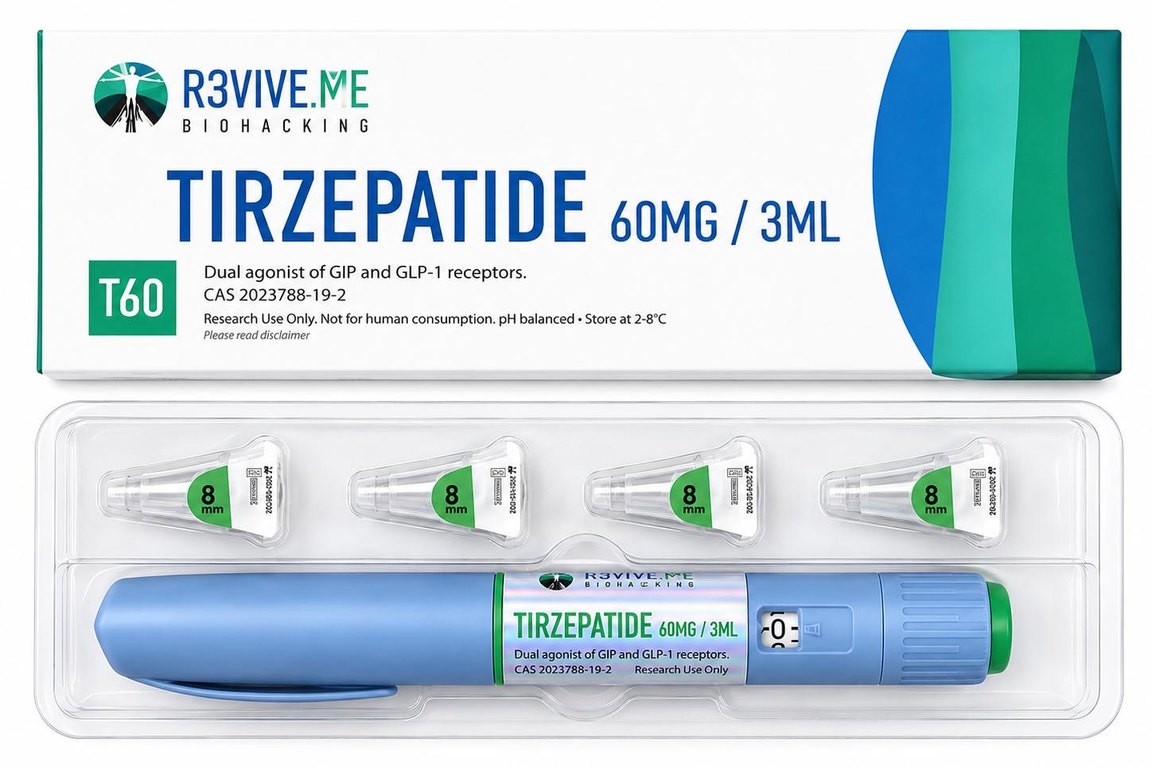
Our Tirzepatide 60mg is a 3 ml pen, 20 mg/ml by the label, pH balanced, at 99% purity, with 4 pen needles in the box. The peptide is already in solution, so there is no powder to measure out. Store at 2–8°C and refrigerate on arrival. Most UK shops sell Tirzepatide as vials of lyophilised powder; see peptide pen vs vial for the difference.
Sources
- NCATS GSRS, UNII OYN3CCI6QE: sequence, checked 5 November 2026.
- PubChem, CID 166567236 (tirzepatide): formula, molar mass and CAS number, checked 5 November 2026.
- Coskun et al., Molecular Metabolism, 2018, doi:10.1016/j.molmet.2018.09.009.
- Zhao et al., Nature Communications, 2022, doi:10.1038/s41467-022-28683-0.
- Sun et al., PNAS, 2022, doi:10.1073/pnas.2116506119.
- ClinicalTrials.gov: the SURPASS and SURMOUNT registrations.
- catalogue/products.json: R3vive strength, volume, contents and storage line.
Products in this guide


All products are supplied for research purposes only.